
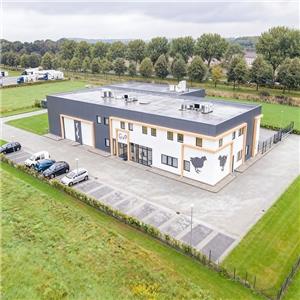
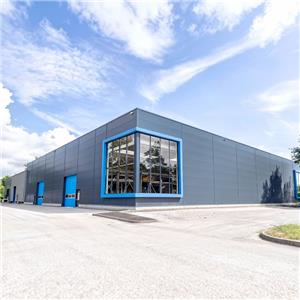
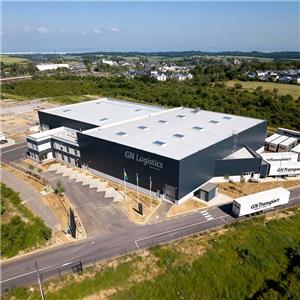
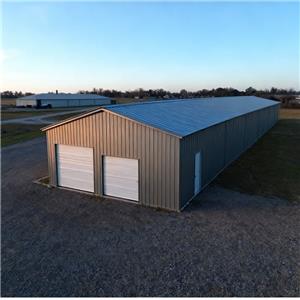
Fábrica com estrutura de aço na Cidade Econômica Rei Abdullah, Arábia Saudita — Fábrica de Processamento de Alimentos
Project Overview
This prefabricated steel structure factory building is located in the Industrial Zone of King Abdullah Economic City (KAEC) on the Red Sea coast of Saudi Arabia, approximately 100 kilometers north of Jeddah. The client is a food processing company producing packaged food products for the Saudi domestic market and for export to GCC countries through the KAEC port facility.
The project required a factory building that met both the structural requirements of a large-span industrial building and the hygienic design standards required for food production under Saudi Food and Drug Authority regulations and international food safety standards. The production hall needed to be large enough to accommodate complete production lines from raw material intake through processing, packaging, quality control, and dispatch, all under a single roof.
Meituo Buildings supplied the complete pre-engineered steel structure system with food-grade compatible interior finishing, including smooth-face PU sandwich wall panels, hygienic ceiling system, positive-pressure ventilation with HEPA filtration for critical production zones, and full engineering documentation including structural calculations and food facility design compliance review.
Project Specifications
The factory has a total floor area of 9,000 square meters across two connected building sections. The main production hall is 60 meters wide and 120 meters long with a 9-meter eave height. An attached finished goods warehouse section is 30 meters wide and 60 meters long with a 7-meter eave height, connected to the production hall by an internal doorway system.
The 60-meter clear span of the main production hall was a specific client requirement, driven by the need to install parallel production lines of the full line length without column interruptions. This span requires a heavier portal frame than the standard industrial range, with primary column and rafter sections optimized using pre-engineering software to minimize steel weight while meeting the structural performance requirements.
All primary structural steel is Q355B welded H-section, shot-blasted to Sa 2.5 and coated with an epoxy primer and polyurethane topcoat system rated for the KAEC coastal corrosion environment. Secondary framing is hot-dip galvanized throughout.
Food-Grade Interior Design
The interior of the production hall uses a complete smooth-surface panel system that is washable, non-absorbent, and resistant to the food-grade cleaning chemicals used in the facility's daily sanitation programme.
Wall panels are 75-millimeter PU sandwich panels with smooth white polyester-coated steel interior faces. At the floor-wall junction, 200-millimeter radius coved stainless steel coving profiles eliminate right-angle joints that accumulate food debris and are difficult to clean. All horizontal ledges, sills, and structural recesses in the production areas are sloped at a minimum of 45 degrees to prevent accumulation.
The ceiling system in production areas is suspended from the structural roof purlins at a height of 5 meters above the finished floor, creating a concealed services void above. The suspended ceiling panels are smooth white polyester-coated steel panels in a clip-fixed system that allows individual panels to be removed for services maintenance access.
Lighting is provided by sealed food-safe LED luminaires rated IP65, mounted flush in the suspended ceiling. All light fittings include shatter-proof covers in compliance with SFDA requirements for food production areas.
Wall penetrations for services such as electrical conduits, air supply ducts, refrigerant pipes, and drainage connections are all sleeved with stainless steel collars sealed with silicone to prevent moisture ingress behind the wall panels.
Ventilation and Air Handling
The ventilation and air handling design for this food processing facility was developed in coordination with the mechanical and electrical engineer and the HACCP food safety consultant retained by the client.
The main production areas operate under slight positive pressure relative to the external environment, preventing unfiltered outdoor air from entering through any gaps in the building envelope. Air supply to production areas passes through bag filters and HEPA final filters to remove particulates and airborne microorganisms that could contaminate open food products.
Raw material intake and waste disposal areas are maintained at neutral pressure and ventilated separately from production areas, preventing cross-contamination of air streams. Exhaust from these areas is discharged through roof-mounted fans directly to atmosphere without recirculation.
The building roof uses 100-millimeter PU sandwich panels with high-reflectivity white exterior coating, minimizing solar heat gain into the production areas and reducing the cooling load on the central air handling units. Ridge vents are not used in the production building to avoid any uncontrolled air movement; all ventilation is through the mechanical systems.
Loading and Dispatch Area
The dispatch area at the east end of the building has four ground-level roller shutter doors of 4 meters width and 4 meters height for dispatch vehicle access. A temperature-controlled dispatch lobby of 300 square meters between the finished goods warehouse and the loading area maintains an intermediate temperature of 15 degrees Celsius, acting as a buffer zone to protect temperature-sensitive packaged goods during loading.
An external truck parking and maneuvering area with a concrete hardstanding capable of carrying fully loaded 40-tonne articulated vehicles is provided on the east side of the building, with a turning radius sufficient for the longest container trucks serving KAEC.
KAEC Zone Requirements
KAEC industrial zone authority required submission of structural engineering calculations, fire safety design, and drainage design as part of the building permit application. All documentation was prepared with reference to Saudi Building Code requirements and submitted in both English and Arabic. Building permit approval was received within 21 days of submission.
KAEC is a designated industrial free zone with its own port facility providing direct export access. The customs and logistics advantages of the KAEC location are a key reason for the client's decision to locate the production facility there, and the building's dispatch area design reflects the requirements for direct-to-port container loading.
Construction Timeline
Total construction time from site mobilization to client handover was 118 days. Foundation construction took 28 days. Steel frame erection took 16 days. Roof and wall panel installation took 20 days. Suspended ceiling, services, and clean room fit-out took 35 days, running in parallel with external works including hardstanding and drainage. Equipment installation by the client's equipment contractors was completed in a further 30 days after structure handover, with SFDA inspection and approval received at day 148 from project start.
Project Outcome
The facility achieved SFDA food production facility approval and began commercial production within five months of the initial site mobilization. The client reports that production capacity at the KAEC facility has exceeded the initial design throughput, and a planning application for a second production bay of 3,600 square meters attached to the existing building has been submitted to KAEC zone authority. Meituo Buildings has been retained for the design and supply of the expansion structure.